

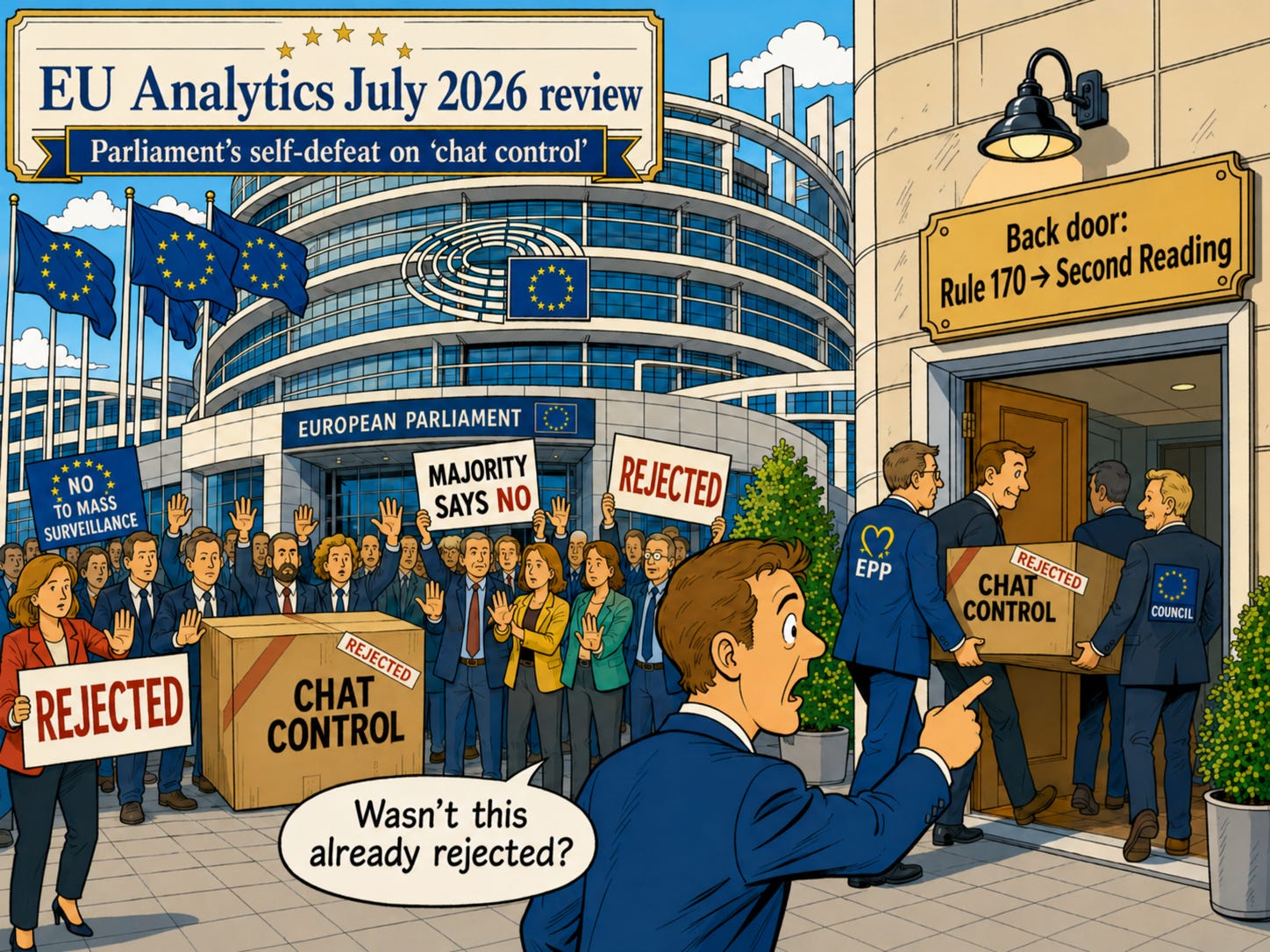
Cover image created with AI.
July was an eventful month for those looking into EU institutions: On ‘chat control’, the EPP used an institutional trick to bypass a majority of Parliament. But beware, on a closer look, in terms of substance the substantiative damage is smaller than made out in the online outcry. For the broader votes, this was another month where the far-right was decisive on quite a few votes, but several of them against rather than with the EPP. Finally, in the Council, only one vote stood out, on the reform of air passenger rights.
Highlight of the month: EP majority failing to stop ‘chat control’
The most politically controversial, but also institutionally illuminating vote this month was a second-reading vote on a temporary derogation from the ePrivacy Directive, or, in political terms, against enabling ‘chat control’. The major twist here was that a majority in the EP voted against it, but not a majority of its members, so that the motion failed, and then the Council moved ahead regardless, all with the support of the EPP and Parliament’s President Metsola. This deserves a bit of unpacking.
First, the political issue. I am looking at this from the institutional angle, not as an expert in online safety. My understanding is that since 2021, a temporary derogation has disapplied parts of the EU’s ePrivacy Directive to allow providers of messaging and mail services to voluntarily scan for child sexual abuse and report it. This derogation was extended to April 2026. The EPP in particular has called for a stricter regime, whereas many opponents in the Parliament and beyond accused the EU of wanting to enable ‘chat control’ and force providers to scan even encrypted material. Based on the objections, in March 2026 the EP’s plenary rejected the Commission’s proposals on this. In a normal procedure, this would have killed the process.
The second point is, however, that the Council and the EPP in the EU Parliament then used a procedural loophole. Rather than accept the outcome, in early July the Council adopted its first-reading position and thus forced a second reading on a proposal the Parliament had just rejected. Crucially, within the ordinary legislative procedure, at second reading the Parliament needs a majority of its members, not just a normal majority, to overrule the Council. Within the Parliament the EPP group with the support of ‘its’ President Metsola then used Rule 170 of the EP’s Rules of Procedure, the urgent procedure, to bring the file straight back to plenary, where 360 MEPs would have been necessary to reject the Council’s position.
The vote then, thirdly, resulted in what amounts to self-defeat of the European Parliament: Whereas 331 MEPs (51 per cent) voted in favour of the position against the Council and ‘chat control’, they fell short of the required threshold of an absolute majority of the House’s component members. The EPP (and, to a lesser extent, the S&D) thus both lost the vote and won the political fight, with huge damage to the EP as an institution. Especially amongst the liberal, but also the far-right and far-left online communities, it was treated as proof of an undemocratic EU, which used procedural tricks to overcome a majority in Parliament. And although the trick was legally correct, in political terms it was exactly that: overruling the majority of Parliament. Interestingly, as part of the procedure, two amendments were successful, one of which was in favour of a permanent carve-out exempting encrypted messages from scanning. And here 362 MEPs voted in favour of the amendment, so the absolute majority of members was there; it just didn’t assemble for the final vote.
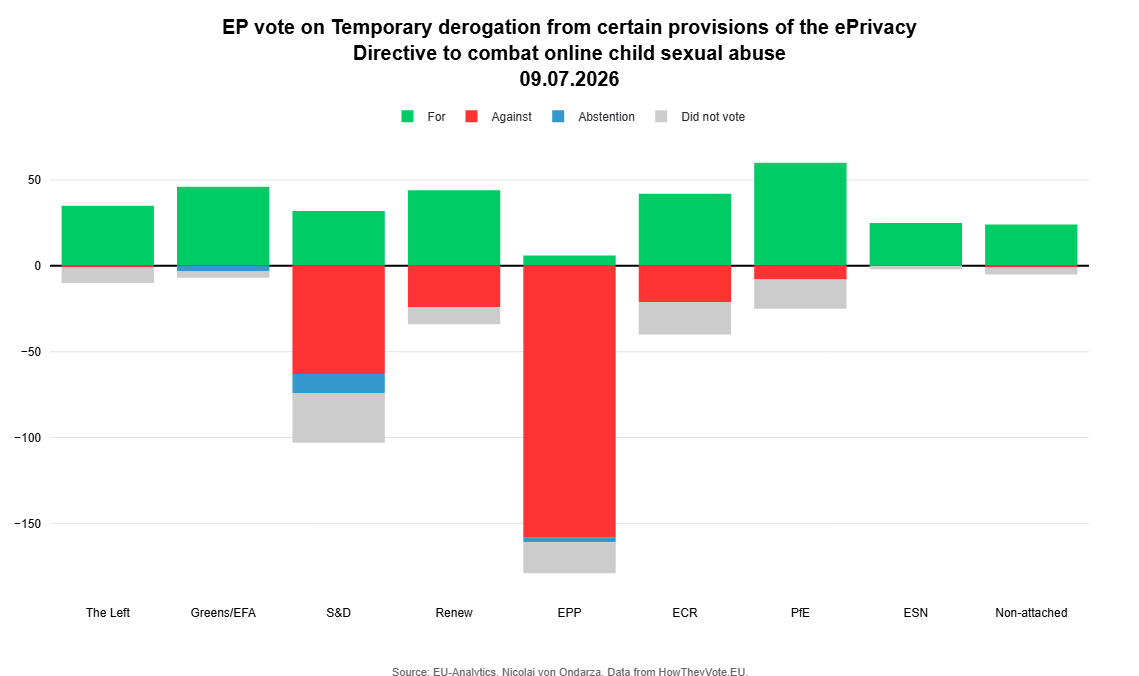
Finally, the follow-up was also rather unusual. Instead of long Council deliberations, on 23 July 2026 the Council adopted the decision, though again on a temporary basis reinstating the derogation until 2028. It did so, however, by including the amendments adopted by Parliament including the carve-out for end-to-end encryption. After all the fighting, the majority in the EP did have the effect of limiting chat control and was not completely overruled by the Council. It also means that the final decisions on this dossier are again kicked down the road.
Institutionally, what remains is the question of whether this was a one-off institutional trick, or something we will see more often, especially on issues where the Parliament is fragmented. The Council, the Commission and the EPP have now learned that using the higher hurdles of second reading is an option on very tight votes. I will certainly keep an eye out for it.
Final votes in the European Parliament
In July 2026, the EP had one plenary session, from 6 to 9 July in Strasbourg. Overall, the plenary had 34 final votes recorded at HowTheyVote.EU. Key topics of the plenary included the contested adoption of the overhaul of air passenger rights, a debate on the June European Council, the starting debate on the 28th regime for the EU single market, a host of annual enlargement reports and the start of the Irish Council Presidency. Looking at the data from these votes, three interesting aspects emerge:
First, this was another plenary where the far-right made its presence felt, as at least one far-right group was decisive for five of the 34 votes, so roughly 15 per cent. As 23 of the 34 votes (67 per cent) were passed by broad consensus, this meant that for almost half of the contested votes the far-right was decisive! However, there were different majorities behind it:
- Only one vote, an objection to land-use for renewable targets (e.g. via biofuels) was passed by a by now traditional ‘Venezuela’ majority of EPP with the three far-right groups.
- One very tight vote, passed by only 50 per cent, on the annual report of the European Investment Bank, was passed by a liberal, centre-right and conservative-right majority of Renew, EPP and ECR, plus a few rebels from the Patriots for Europe.
- Two further votes brought the anti-GM maize majority back together, consisting of majorities of most groups except the EPP. Personally, I have yet to figure out why the EP votes on genetically modified maize so often.
- The fifth vote then was the vote analysed above, where the majority, with the help of the far-right, voted against chat control and the EPP, but failed for procedural reasons.
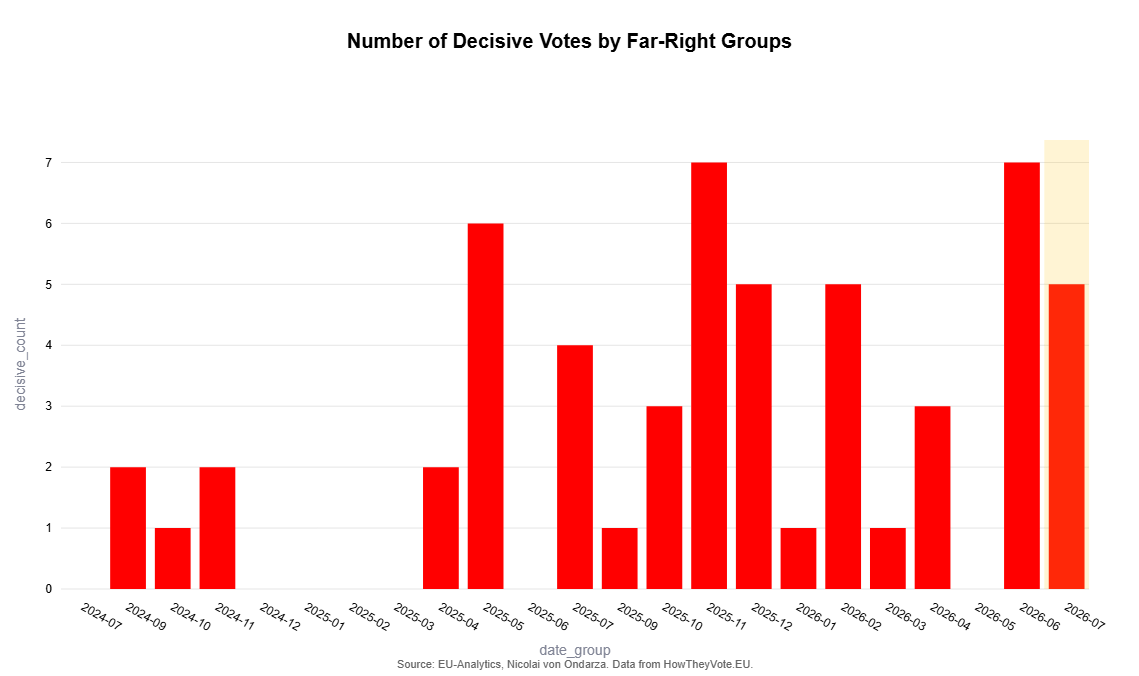
This graph shows the number of times per plenary that far-right groups were decisive for votes. June was higher, but the level remains elevated.
The second observation is that this month the ECR looked more stranded than usual in political no man’s land. With only one ‘Venezuela’ type vote, overall there was a strong overlap in voting within the ‘von der Leyen’ platform groups (EPP, S&D and Renew) and within the harder far right (PfE and ESN), whereas the ECR on this heatmap voted sometimes with the centre, sometimes with the far-right, leaving it stranded between two blocs:
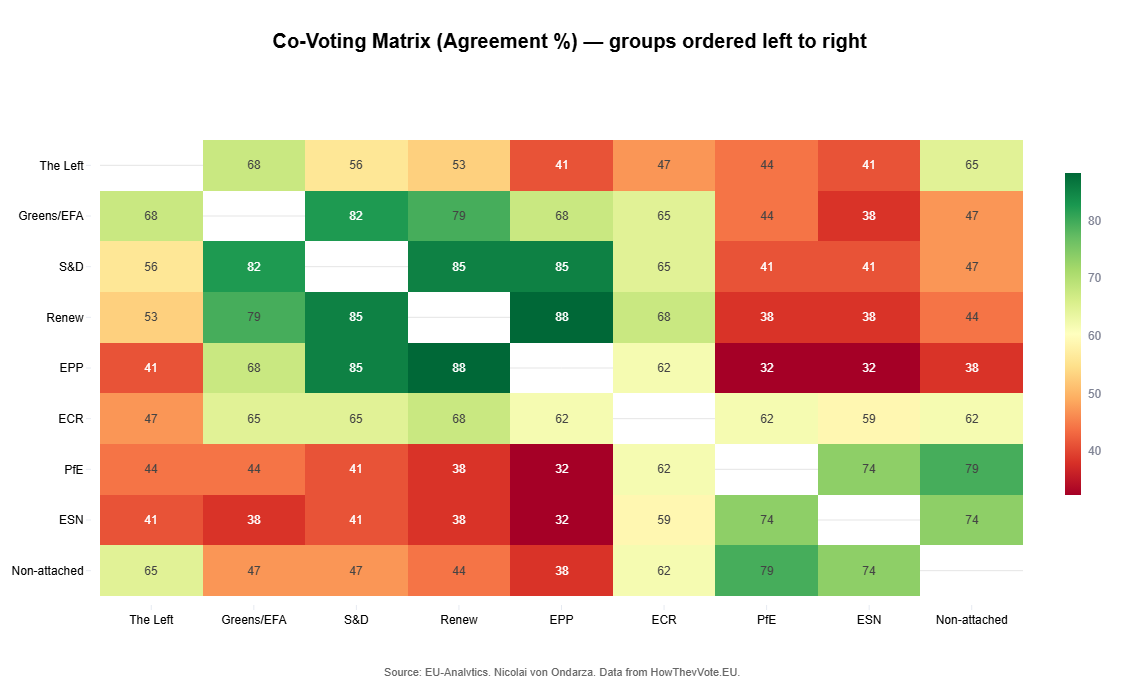
Heatmap of co-voting behaviour in the July plenary. Note the two green centres around the ‘von der Leyen’-platform (plus the Greens) and the two further far-right groups, PfE and ESN.
The third observation concerns EU law-making. Although the treaties envisage a three-stage process in the ordinary legislative procedure, in practice almost all EU law is passed in so-called ‘first-reading agreements’. The change of the air passenger rights has been so controversial that for the first time since 2024 Council and EP could not agree in first or second reading, but had to go through a conciliation committee and finally reached agreement at third reading. This is only the second ‘third-reading agreement’ in the current Parliament. The vote itself, though, was then very, very consensual, with 98 per cent approval and support by all party groups.
Public votes in the Council of the EU
For monitoring the Council votes, the analysis builds upon the public votes published, which are always far fewer than the Parliament’s roll-call votes. For July 2026, summer was already approaching, with only five public votes. Of these, four were adopted by full unanimity, which means an 80 per cent consensus rate, though of course based on very few votes. A few interesting points stood out:
The votes with full unanimity covered a broad range of topics: data protection, extending the access of the European Public Prosecutor’s Office (EPPO) and OLAF to EU-wide value added tax (VAT) information, support amid rising fertiliser prices and finally a special mechanism to allow a bilateral agreement between Austria and Switzerland.
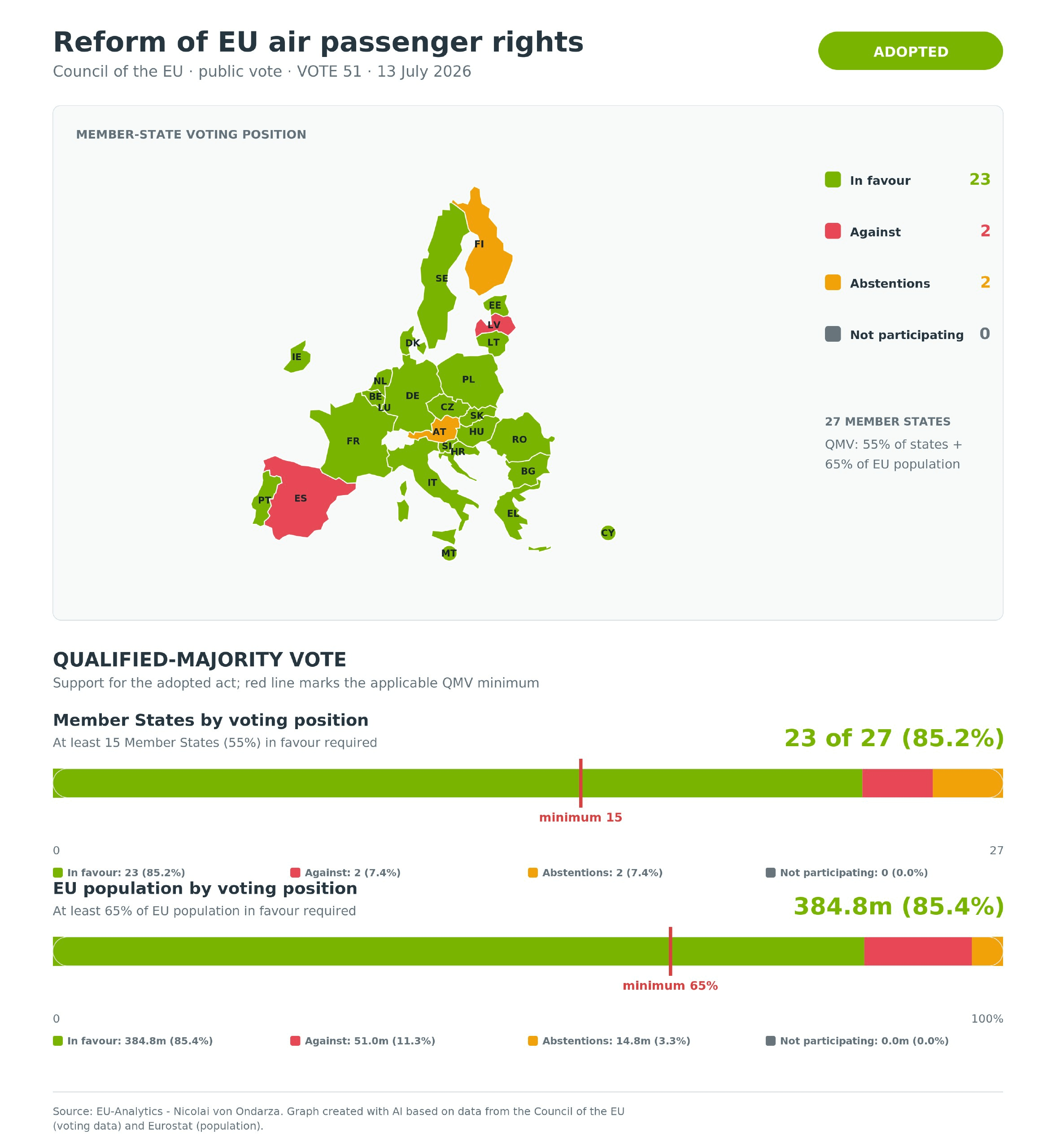
The one more controversial vote has a special history: it was a vote on air passenger rights protection, which was passed with two no votes (Spain, Latvia) and two abstentions (Austria, Finland). This was not an obvious blocking coalition, but in my view rather brought together sceptics with different motives. The reform itself was also controversial between the Council and the European Parliament, passing in a very, very rare case only after a conciliation committee in third reading (see above):
That’s a wrap! If you liked the analysis, please subscribe for more. You will get at least monthly reviews, plus the occasional additional quick institutional analysis. Here is also my policy on using AI for EU-Analytics.
Comments and Feedback always welcome!