

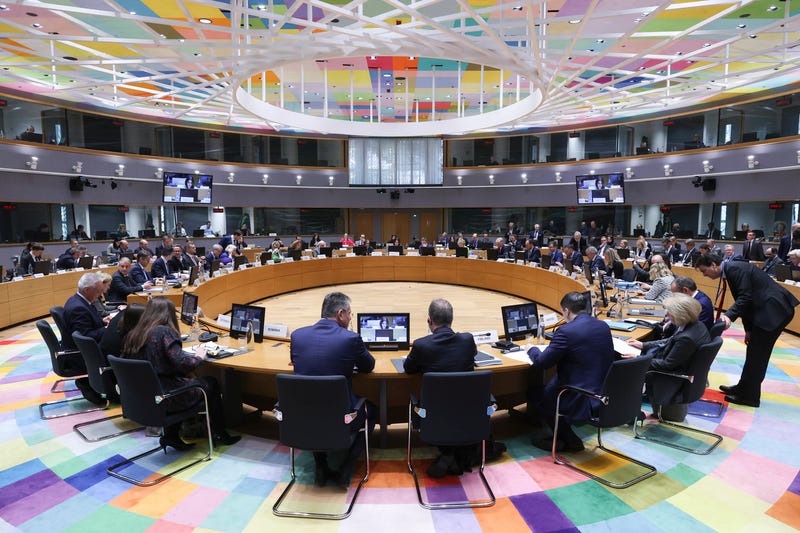
Meeting of the General Affairs Council, 17 March 2026. © European Union, 2026.
August remains a quiet month for European politics. There was no plenary of the European Parliament, and there were no formal Council sessions or public votes. So I am using this month’s EU-Analytics newsletter to take a deeper look into the Council votes of the past year (July 2025 to July 2026) and a subtle change becomes visible: EU member states are more willing to go for controversial votes based on slim majorities, and there is a new outlier in town.
Still a compromise machine, but with less consensus
Overall, there were 97 public votes in the Council in these thirteen months. Traditionally, the Council is often viewed as a ‘compromise machine’, where governments negotiate until they reach a consensus, even where majority votes are possible. The last thirteen months, however, showed that frictions in national politics are also making themselves felt in the Council. Before we dive in, an important caveat: these are only the public votes of the Council, which are still only part of the votes that take place in it. Additionally, the Council usually only votes once governments have negotiated a large degree of agreement, which is why we never see a rejection in the Council. With these limitations in mind, let us look at the data:
First, while consensus was still high, it is noticeably lower than in previous years. Of the 97 votes, ‘only’ 52 (53.6 per cent) were adopted by unanimity, with a further 19 (19.6 per cent) adopted with abstentions only. This is still a remarkable degree of consensus for today’s fractured EU politics, but in other years up to 90 per cent of Council votes were in consensus, i.e. either unanimous or with only abstentions. In particular the first half of 2026 saw this consensus rate fall to just above 70 per cent, amongst the lowest in the last decade.
At the same time, there were 26 votes with at least one no-vote, fourteen of which had two or more national governments saying no to an EU proposal. In previous years, such votes were rare. Even where the Council can decide by qualified majority, governments usually strive for consensus to retain legitimacy. Add high-profile contested votes, such as on the trade agreement with Mercosur, and you can see a growing willingness to put ‘capacity to act’ above unity.
In a mature, democratic union challenged by geopolitical empires of the US, Russia and China, the willingness to move faster is important. But it also opens the Union to criticism over its legitimacy if countries are regularly outvoted on critical issues. For now, with a consensus rate of slightly above 70 per cent, I would argue this is still not the case. But if it dipped much lower, that would become problematic.
The different stories behind outvoted governments
I count a government as outvoted whenever it did not vote in favour, either by abstaining or by voting no. On that measure, the past thirteen months tell quite different stories. First, it is noteworthy who was not outvoted at all over the past thirteen months: These were all small states, Cyprus, Ireland, Lithuania and Luxembourg. This does not mean that they always agreed, but that they negotiated well enough to carve out something for themselves and accept the final compromise. Smart small state diplomacy in the EU.
In contrast, France and Germany are both in their own ways less successful in the Council than before. The French government used to be almost never outvoted, but was outvoted twice in the last year alone, after just three times in more than 1500 votes over the previous fifteen years. Germany with seven instances of being outvoted (three abstentions, four no votes) was even among the most often outvoted EU countries. This shows that in an EU where the Council is more willing to outvote national governments, this does not only or even predominantly concern small states. Even the largest EU countries were on the receiving end of being outvoted. Spain also deserves to be highlighted: It voted no five times, together with Sweden the second-highest number of straight no votes after Hungary. As the last large EU member state government from the social democratic camp, Spain has found itself increasingly on the margins of EU politics in a very different way from Hungary under Orbán.
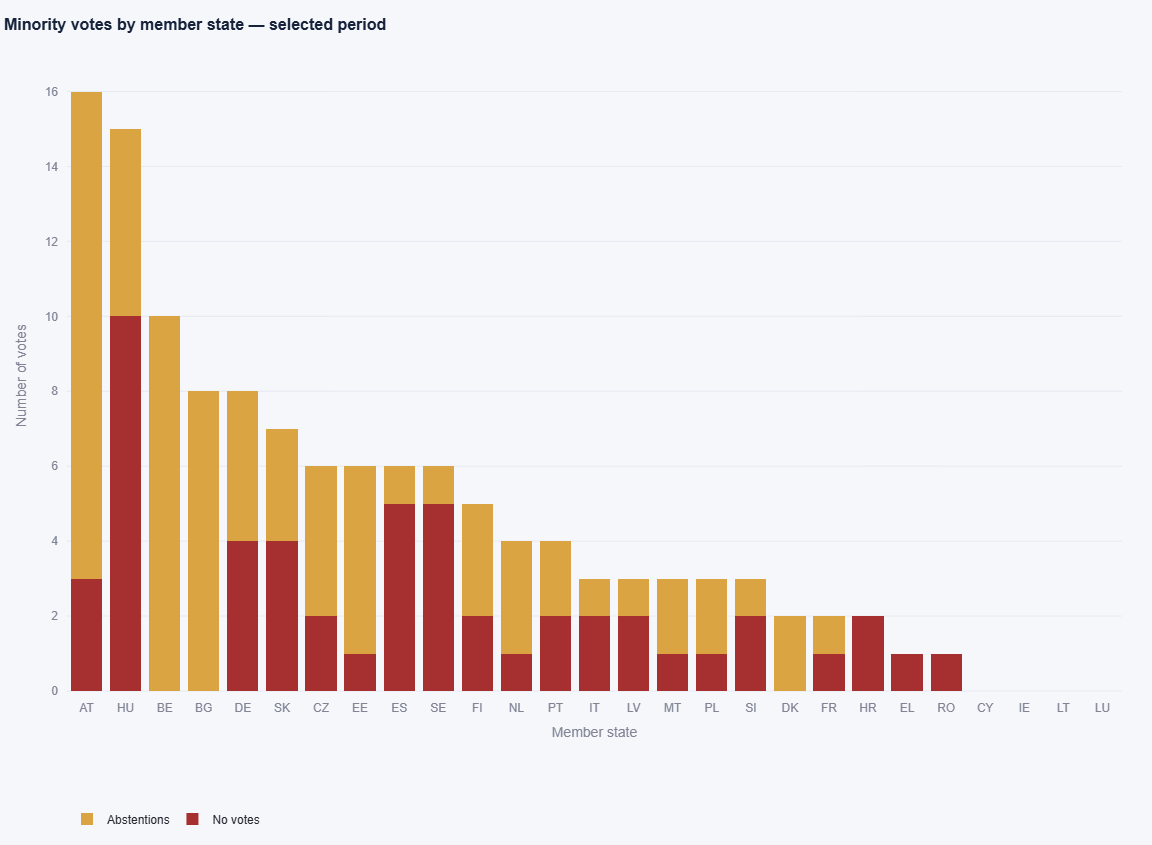
Number of abstentions and no votes in the Council from July 2025 to July 2026. Own compilation based on data from the Council of the EU.
At the overall top of the list of countries most often outvoted there were two different groups of countries:
· National governments that often abstained, either due to national government crises (Bulgaria, eight abstentions), internal fights in coalitions (Austria, twelve abstentions) or both (Belgium, nine abstentions).
· Governments drifting further from the rest of the EU: Slovakia (outvoted nine times) and Hungary under Viktor Orbán (outvoted fourteen times). But even Hungary still voted with the rest of the EU in 84 per cent of votes.
Taken together, and compared to last year’s analysis of Council voting data, the shifts in EU politics remain subtle but noticeable. The last thirteen month saw a little bit less consensus and more willingness for tight majorities. What struck me most is the exposed position of Spain, which I will keep a special eye on in the future.
That’s a wrap. If you liked the analysis, please subscribe for more. You will get monthly reviews, plus the occasional additional quick institutional analysis. Here is also my policy on using AI for EU-Analytics.
Comments and Feedback always welcome!